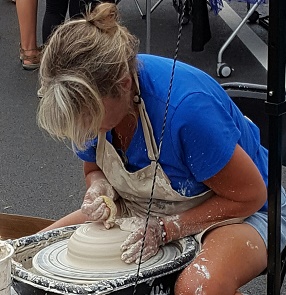
Wheel throwing is one of the oldest mechanically assisted forming methods in ceramics. The potter's wheel — known as a kick wheel when foot-powered, or a motorised banding wheel in electrified studios — creates a rotating platform on which centrifugal force and hand pressure interact to raise clay into hollow forms. Despite its apparent simplicity, throwing consistently demands a precise sequence of hand positions, body weight management, and an intuitive read of the clay's hydration state.
Preparing the Clay: Wedging and Hydration
Before any clay touches the wheel head, it must be wedged. Ram's-head wedging and spiral wedging both accomplish the same goal: eliminating air pockets and homogenising the clay's moisture content. Uneven moisture causes the clay to behave erratically during centring — one side of the mound will be softer than the other, and the off-centre pull will fight every correction.
In Canadian studios, where humidity varies significantly between coastal and prairie environments, clay hydration is rarely left to chance. Most commercial stoneware bodies arrive at 20–22% moisture by weight, but a clay left unwrapped in a dry Alberta studio for two weeks may drop to 16–18%, making it noticeably stiffer. Rewedging with added water in small amounts — applied to the cut face of the wedged clay rather than the surface — is a reliable correction.
Centring: The Foundation of Everything That Follows
Centring is where most beginners spend the majority of their time, and rightly so. A mound of clay that wobbles on the wheel head will transmit that wobble into every subsequent step. The clay is not "wrong" — it simply hasn't yet been persuaded into alignment with the wheel's axis.
Effective centring relies on two opposing forces: downward compression from the heel of the dominant hand, and inward pressure from the braced secondary hand. The elbows should be anchored against the thighs or the wheel tray, not floating in the air. Floating elbows allow the hands to be pushed back by the clay rather than holding their position.
The wheel speed during centring is typically the fastest in any throwing session — most potters run the wheel at 80–100% of its capacity until the mound stops wobbling, then slow down incrementally as they transition to opening and pulling.
Common Centring Problems
A mound that centres at the top but still wobbles at the base is a sign that the clay hasn't been fully contacted at its attachment to the wheel head. Cone the clay up fully — even if you don't need the height — and then compress it back down with even pressure before attempting to open. This resets the clay's orientation relative to the axis.
Opening and Pulling Walls
Once centred, the clay is opened by pressing straight down into its centre with the fingers of the dominant hand, stopping approximately 1 cm from the wheel head to preserve the floor of the form. The opening defines the interior diameter and sets the floor thickness — a measurement that can't be recovered once the walls are pulled.
Pulling the walls involves simultaneous inward pressure from the outside fingers and upward movement of both hands, with the inside fingers slightly higher than the outside to avoid cutting through the clay. The clay should be thought of as flowing upward through the finger-gap rather than being stretched by it. Each pull should lift the wall slightly higher and thin it by a consistent amount.
Water is used sparingly. Excess water is the most common cause of slumping walls in student work — the clay becomes saturated and loses structural memory. Professional studio potters often throw with less water than beginners expect, relying instead on consistent compression and correctly wedged clay.
Shaping: Cylinders, Bowls, and Altered Forms
A thrown cylinder is the foundation of most wheel-thrown forms. Bowls are opened cylinders whose walls are encouraged outward rather than kept vertical. Vases are cylinders whose upper walls are collared inward. Understanding the cylinder as a neutral form that is then modified — rather than aiming directly for the final shape — gives the thrower more control over the finished piece.
Alteration at the leather-hard stage is common in contemporary Canadian studio practice. Faceting with a metal kidney or wire tool, paddling to create flat sides, and pulling feet are all performed after the piece has stiffened enough to hold the intervention without distorting elsewhere.
Trimming and Foot Rings
Trimming on the wheel is performed when the clay has reached a leather-hard state — firm to the touch, slightly cool, with no visible surface sheen. The piece is inverted and centred on the wheel head, then held in place either by clay coils pressed around the rim or by a chuck. A trimming tool removes excess clay from the foot area and defines the foot ring.
The foot ring's proportions significantly affect how a finished piece reads. A narrow, tall foot ring lifts the bowl visually and signals a more refined intent. A wide, low foot ring grounds the form and is associated with utilitarian stoneware traditions. Neither is correct — the choice depends on the clay body, the glaze, and the intended use.
Drying and Bisque Firing
Thrown pieces must dry slowly and evenly to avoid cracking. Covering loosely with plastic for the first 24–48 hours — particularly in dry climates — slows surface evaporation and allows the interior moisture to migrate outward uniformly. Forcing the drying process, especially near a heat source, causes differential shrinkage between the rim, walls, and base, often resulting in S-cracks in the floor.
Bisque firing — typically to cone 06 or cone 04, roughly 1000–1050°C — removes chemically bound water and converts the clay to a porous, stable state that accepts glaze readily. The bisque temperature must be chosen in relation to the intended glaze-firing temperature: a bisque that is too close in temperature to the glaze fire will have sealed the surface too much for adequate glaze adhesion.
For further technical reference, the Ceramic Arts Network maintains a detailed archive of throwing and trimming tutorials sourced from studio professionals.

